
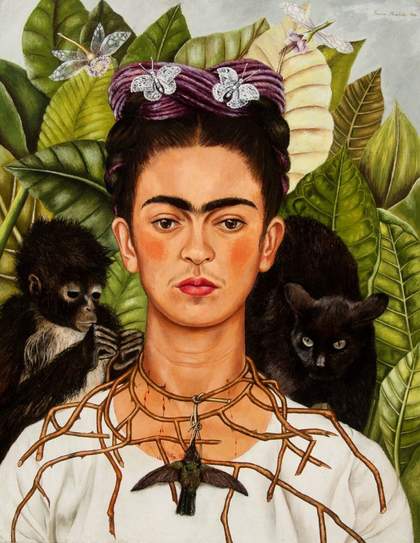
FRIDA KAHLO. The Making of an Icon.
Kaum eine Künstlerin der Moderne hat das eigene Selbst so konsequent zum Gegenstand ihrer Kunst gemacht wie Frida Kahlo. Kahlo schuf ungefähr 55 Selbstporträts bei einem Gesamtwerk von rund 140–150 Gemälden. Damit macht die Selbstdarstellung einen ungewöhnlich hohen Anteil ihres Œuvres aus. Es gibt zwar Künstlerinnen und Künstler, die zahlenmäßig wesentlich mehr Selbstporträts geschaffen haben – etwa Rembrandt oder später Künstlerinnen, bei denen fotografische bzw. performative Selbstinszenierung zum zentralen Verfahren wird.
Entscheidend ist bei Kahlo meines Erachtens deshalb nicht die absolute Zahl, sondern etwas anderes: die nahezu obsessive Kontinuität der Selbstbefragung und die enorme Bandbreite dessen, was über das eigene Bild verhandelt wird – Körper, Krankheit und Verletzung, Sexualität, Gender, ethnisch-kulturelle Identität, Begehren, Mutterschaft/Nicht-Mutterschaft, politische Zugehörigkeit, Tod und schließlich die Konstruktion der Persona „Frida Kahlo“. Frida Kahlo malt nicht einfach sich selbst. Sie produziert in ihren Bildern immer wieder neu ein „Frida“ genanntes Subjekt. Gerade diese radikale Verschränkung von Leben, Körper, Selbstbild und künstlerischer Autorschaft macht ihr Werk zu einem Modell, an dem sich sowohl frühere Formen weiblicher Selbstkonstitution neu befragen als auch spätere künstlerische Positionen messen lassen.Diese Vielschichtigkeit in den künstlerischen Selbstkonstitutionen ist explizit Thema der Ausstellung FRIDA. The Making of an Icon in der Tate Modern (noch bis 3.1.2027):
https://www.tate.org.uk/whats-on/tate-modern/frida-kahlo-the-making-of-an-icon
Im zweiten Teil der Tate-Ausstellung werden den Arbeiten von Frida Kahlo Werke von mehr als 80 zeitgenössischen und später von ihr beeinflussten Künstler:innen gegenüber. Im Zentrum stehen also nicht nur Kahlo und ihre Biographie, sondern auch Rezeption, Fandom, Identifikation und die unterschiedlichen Communities, die Frida für sich beanspruchen.
Warum ermöglicht gerade Frida Kahlos Selbstbild so vielen anderen Frauen, sich selbst darin wiederzufinden, obwohl dieses Selbst zugleich historisch, kulturell und biographisch höchst spezifisch ist? Dieser zentralen Frage wollen wir im Wintersemester gemeinsam nachgehen.
FRIDA KAHLO. The Making of an Icon. Hardly any other modern artist has made the self the subject of her art as consistently as Frida Kahlo. Kahlo created approximately 55 self-portraits out of a total body of work comprising around 140–150 paintings. Thus, self-portraiture accounts for an unusually high proportion of her oeuvre. There are, of course, artists who have created significantly more self-portraits in terms of numbers—such as Rembrandt or, later, female artists for whom photographic or performative self-staging became a central practice. In my view, what is decisive in Kahlo’s case is therefore not the absolute number, but something else: the almost obsessive continuity of self-examination and the enormous range of what is explored through her self-portraits—body, illness and injury, sexuality, gender, ethnic and cultural identity, desire, motherhood/non-motherhood, political affiliation, death, and finally, the construction of the persona “Frida Kahlo.” Frida Kahlo does not simply paint herself. In her paintings, she continually recreates a subject she calls “Frida.” It is precisely this radical intertwining of life, body, self-image, and artistic authorship that makes her work a model against which both earlier forms of female self-constitution can be reexamined and later artistic positions can be measured. This complexity in artistic self-constitution is the explicit focus of the exhibition FRIDA. The Making of an Icon at the Tate Modern (through January 3, 2027): https://www.tate.org.uk/whats-on/tate-modern/frida-kahlo-the-making-of-an-icon In the second part of the Tate exhibition, Frida Kahlo’s works are juxtaposed with those of more than 80 contemporary artists and those influenced by her later on. The focus is thus not only on Kahlo and her biography, but also on reception, fandom, identification, and the various communities that claim Frida as their own. Why is it that Frida Kahlo’s self-image, in particular, allows so many other women to see themselves reflected in it, even though this self-image is, at the same time, highly specific in historical, cultural, and biographical terms? We will explore this central question together during the winter semester.
FRIDA KAHLO. The Making of an Icon. Hardly any other modern artist has made the self the subject of her art as consistently as Frida Kahlo. Kahlo created approximately 55 self-portraits out of a total body of work comprising around 140–150 paintings. Thus, self-portraiture accounts for an unusually high proportion of her oeuvre. There are, of course, artists who have created significantly more self-portraits in terms of numbers—such as Rembrandt or, later, female artists for whom photographic or performative self-staging became a central practice. In my view, what is decisive in Kahlo’s case is therefore not the absolute number, but something else: the almost obsessive continuity of self-examination and the enormous range of what is explored through her self-portraits—body, illness and injury, sexuality, gender, ethnic and cultural identity, desire, motherhood/non-motherhood, political affiliation, death, and finally, the construction of the persona “Frida Kahlo.” Frida Kahlo does not simply paint herself. In her paintings, she continually recreates a subject she calls “Frida.” It is precisely this radical intertwining of life, body, self-image, and artistic authorship that makes her work a model against which both earlier forms of female self-constitution can be reexamined and later artistic positions can be measured. This complexity in artistic self-constitution is the explicit focus of the exhibition FRIDA. The Making of an Icon at the Tate Modern (through January 3, 2027): https://www.tate.org.uk/whats-on/tate-modern/frida-kahlo-the-making-of-an-icon In the second part of the Tate exhibition, Frida Kahlo’s works are juxtaposed with those of more than 80 contemporary artists and those influenced by her later on. The focus is thus not only on Kahlo and her biography, but also on reception, fandom, identification, and the various communities that claim Frida as their own. Why is it that Frida Kahlo’s self-image, in particular, allows so many other women to see themselves reflected in it, even though this self-image is, at the same time, highly specific in historical, cultural, and biographical terms? We will explore this central question together during the winter semester.
- Trainer/in: Elisabeth